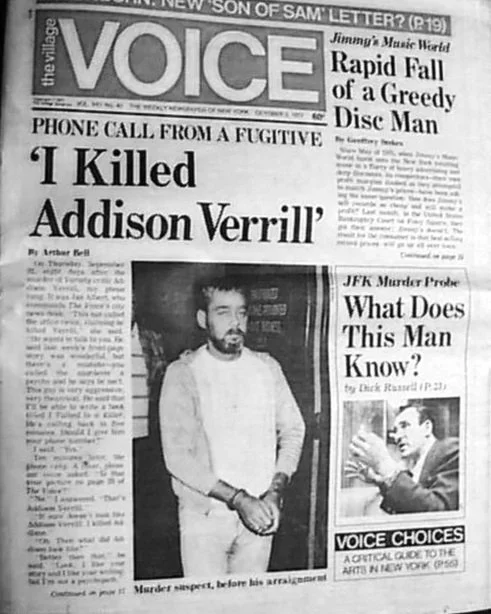
The Bag murders
The Bag Murders were a set of murders that occured in New York City between the years of 1975 and 1977, when trash bags containing male human remains were found floating in the hudson were discovered by law enforcement. No identifications were ever made and both the victims and killer remain unknown. However there is a prime suspect for the killings, a man named Paul Bateson, who in 1977 was convicted of killing a reported name Addison Verrill. Bateson was never arrested or tried for the Bag Murders due to a lack of evidence tying him to the case.
Victims (convicted and unconfirmed)
Unconfirmed
(bateson suspected)
Convicted
(bateson)
Unknown male victim
1970’s
Unknown male victim
1970’s
Unkown male victim
1970’s
Unknown male victim
1970’s
SEPTEMBER 1977
Unknown male victim
Unknown male victim
1970’s
1970’s
Addison verrill
aug 1940
August 23 1940 - Paul Bateson is born in Lansdale, Pennsylvania.

1973 - Bateson begins his job as a neurological radiological technician.
1973 - Bateson worked as a neurological radiological technician at New York University Medical Center. It was via this work that Bateson ended up as an extra in The Exorcist.
1973
1975 - 1977
1975 - Bateson is let go from his job due to his alcoholism affecting his working performance. After his firing bateson attended AA meetings to get sober and was somewhat successful.
1977 - Bateson starts drinking again, more heavily than he had before getting sober, which may have contributed to his later actions.
1975 to 1977 - several male dismembered human remains are discovered floating in trash bags in the Hudson, which leads to an investigation.
1975 - 1977
sep 1977
September 14 1977 - reporter Addison Verrill is murdered by Paul Bateson in his apartment on Horatio Street. The police believed the motive might have been robbery.
September 1977 - A friend of Verrill's, Arthur Bell, wrote an article regarding Verrill's murder after the police deemed his death a robbery gone wrong. He wrote about the neglect of the murders of gay men and how they weren't taken seriously by law enforcement.
sep 1977
sep 1977
Sep 22 1977 - Bell receives a call from a man claiming to be the killer. The killer recounted the events to Arthur, detailing bar hopping, drinking, the eventual sex, and what led to the murder. After the call, Bell contacted law enforcement.
Sep 22 1977 - Bell, accompanied by police, would later get another call, this time from a different caller identifying as “Mitch”. This caller would inform Bell that the killer was Paul Bateson and that he had called Mitch earlier to confess the crime.
1977 - Bateson is arrested after his phone call with Bell, after-which giving the police a hand written confession that matched the story Bell gave.
March 1 1979 - Bateson goes on trial for Verrill’s murder
1979 - The police believe Bateson is connected to the bag murders, as a witness who was at his trial, Richard Ryan, had claimed that Bateson had come to him and confessed to the murders of three other men in early 1973. He also claimed that Bateson had admitted to killing and dismembering six men, whom he dumped in the Hudson. However, there was no evidence to support these claims, so no charges were brought forward.
March 5 1979 - Bateson is convicted of the murder of Addison Verrill.
mar 1979
1979 - 1980
1979 - William Friedkin, who had directed The Exorcist, visited Bateson in jail during his trial. during this visit Bateson allegedly was given the opportunity of a plea deal if he confessed to the bag murders, but declined.
1980 - Friedkin, used Bateson's story as inspiration for his movie Cruising, which was based on the 1970 novel of the same name.
2003 - Bateson is released from prison after becoming eligible for parole.
2018 - Matt Miller, a journalist for Esquire, attempts to contact Bateson for an interview but failed to reach him, as the phone number associated with his last known address is disconnected.
Sep 15 2012 - Bateson is believed to have died, via a record showing a man of the same name, birthdate, and social security number passed in New York City.
2003 - 2012
The impact of the bag murders
The bag murders left a sense of fear in the queer community, a fear that they could be next, the next unidentified body to end up in the Hudson. What made this fear worse was the police's treatment of the case after discovering that the clothing found with the bodies came from a part of NYC that was infamous for being a Queer space. After Bateson’s arrest, it seemed as if the police were willing to let the case go cold after his decline for the plea. This reiterated the fact that crimes and violence against the queer community would get swept under the rug or pushed off because it’s not as important as other cases BECAUSE they were committed against queer people. Even the article Verrill's friend Bell wrote supports the fact that the police didn't care about the crime if it was happening to gay people. Not only did this reinforce the ideas surrounding the NYPD amongst the queer community in NYC, but it was also directly physically harmful, and indirectly harmful due to their neglect. Even Friedkin, creating a movie he was inspired by, via the events of the bag murders, was a harmful and incorrect depiction of the queer bar scene. Up until the Last Call killings in the 90’s, this pattern of behaviour in the NYPD and media continued until there was so much pushback from activists and the queer community that they HAD to change. To this day, the murders are still cold, with no justice or identities being brought to these six men who tragically lost their lives. forgotten and pushed aside by the NYPD because of homophobia and prejudice.